FPV Controllers: The Gimbal Specs Your Thumbs Will Feel
Updated 2026-08-30 · By the SpecRiot Editors
An FPV radio controller is the transmitter that carries your stick inputs to the quad, and it is the only piece of gear you keep across every drone you will ever own. What you are buying is gimbal precision and protocol reliability, not more switches. Gimbal type. Protocol. Channel count. Open firmware. Here is what separates radios that feel surgical from radios that drift mid-flight. As one pilot put it: "Your quad is disposable. Your radio is a marriage. Choose accordingly."
As an Amazon Associate, I earn from qualifying purchases. SpecRiot is reader-supported. No paid placements. No press samples. No manufacturer relationships.Full disclosure.
What Actually Matters When You Compare Fpv Controllers
Gimbal quality:Hall-effect gimbals (TX16S, Boxer, Pocket) measure stick position without contact, so they do not wear or jitter. Potentiometer gimbals are cheaper and eventually drift. Gimbal quality is stick honesty, and stick honesty is your entire feel.
Protocol:ELRS (ExpressLRS) is the open-source 2.4GHz standard: long range, low latency, and open firmware. Multi-protocol modules add legacy compatibility. ELRS is the protocol the whole hobby standardized on.
Channel count:16 channels (TX16S, Boxer) leave room for arm switches, modes, beeper, and LED channels. Pocket's compact layout covers the essentials. Buy channels for the future, not the first quad.
Firmware:EdgeTX/OpenTX give you Lua scripts, mixes, and voice alerts on an open platform. Open firmware is the difference between a radio and a toy with a screen.
Fpv Controllers: Compared By Published Specs
Best Overall
★★★★★ 9.1/10
RadioMaster TX16S MKII
TX16S MKII (16ch, Hall gimbals, EdgeTX, ELRS)
Channels
16
Gimbals
Hall-effect
Protocol
ELRS, multi-protocol option
Firmware
EdgeTX/OpenTX
Screen
Large color touchscreen
Battery
2S Li-ion (user supplied)
Extras
Voice, haptics, Lua scripts
Price
Under $250
What Works
Hall gimbals, 16 channels, open firmware
The community standard radio
Touchscreen + voice + Lua
Huge resale and support base
The Catch
Bulkier than compact radios
Battery not included
Overkill for a single simple quad
The Bottom Line: The TX16S MKII is the radio the hobby recommends when the budget allows: hall gimbals, EdgeTX, and 16 channels in the most supported transmitter on earth. Buy once, fly every quad you will ever own.
RadioMaster Boxer (16ch, Hall gimbals, carrying case)
Channels
16
Gimbals
Hall-effect
Protocol
ELRS 2.4GHz
Firmware
EdgeTX
Screen
Color
Included
Carrying case
Form
Compact gamepad style
Price
Under $180
What Works
Hall gimbals in a compact body
Full 16 channels on ELRS
EdgeTX open firmware
Carrying case included
The Catch
Smaller screen than TX16S
Single protocol focus
No touchscreen
The Bottom Line: The Boxer is the compact radio that keeps the full feature set: 16 channels, hall gimbals, and EdgeTX in a gamepad-size body. It is the TX16S stripped of bulk, not stripped of capability.
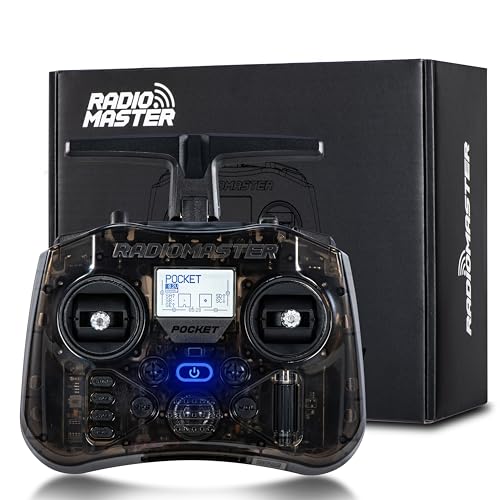
RadioMaster Pocket (portable, Hall gimbal, EdgeTX)
Channels
16 (ELRS)
Gimbals
Hall-effect
Protocol
ELRS 2.4GHz
Firmware
EdgeTX
Screen
Small color
Battery
Not included
Form
Pocket size
Price
Under $90
What Works
Hall gimbal at a budget price
EdgeTX on a pocket radio
Fits in a flight bag
The best first radio
The Catch
Small screen and buttons
Limited switch count
Battery not included
The Bottom Line: The Pocket is the "start flying today" radio: a hall gimbal and EdgeTX for under $90. It is the first radio that does not feel like a toy, and the last one you will need to be talked into.
ExpressLRS (ELRS) is an open-source radio protocol: sub-5ms latency, kilometer-range links, and free firmware updates. It replaced proprietary protocols because it is better and free.
Do I need a multi-protocol radio?
Only if you fly legacy receivers (FrSky ACCST, DSMX, FlySky). If you are starting fresh, ELRS-only is simpler and better. Buy multi-protocol only when a box of old receivers demands it.
How many channels do I really need?
4 channels fly the quad: throttle, roll, pitch, yaw. The rest arm motors, switch modes, trigger beepers, and control LEDs. Most pilots live in the 8-16 channel range.