Waveform Generators: Sample Rate Specs Tell The Truth
Updated 2026-08-30 · By the SpecRiot Editors
A function waveform generator produces precise electrical signals, sine, square, triangle, and arbitrary shapes, to feed into circuits you are testing. What you are buying is signal fidelity and bandwidth. Maximum frequency. Sample rate. Vertical resolution. Channel count. Here is what separates bench-grade generators from the toy modules that put noise in your measurements. As one RF engineer put it: "A waveform generator is the voice of your test bench. If the voice lies, every measurement after it is a rumor."
As an Amazon Associate, I earn from qualifying purchases. SpecRiot is reader-supported. No paid placements. No press samples. No manufacturer relationships.Full disclosure.
What Actually Matters When You Compare Waveform Generators
Bandwidth: The maximum output frequency sets the ceiling. 25-40MHz (Rigol DG1022Z, Siglent SDG2042X) covers audio, control, and most MCU work. 100MHz+ is for RF and high-speed digital. Buy bandwidth for the fastest signal you will actually make.
Sample rate:Sample rate shapes arbitrary waveforms. Higher is smoother. The Siglent SDG2042X samples at 1.2 GSa/s; the Rigol DG1022Z at 125 MSa/s. Sample rate is how honest your arbitrary waves look.
Vertical resolution:14-bit DACs produce cleaner low-level signals with less stair-step noise. Budget DDS units run lower resolution. For audio and precision work, resolution is the spec that matters.
Channels and modulation:Two channels let you generate I/Q pairs, phase-difference signals, and sweeps against a reference. AM/FM/PM modulation matters for radio work. One channel is a signal source. Two is a test bench.
Waveform Generators: Compared By Published Specs
Best Overall
★★★★★ 9/10
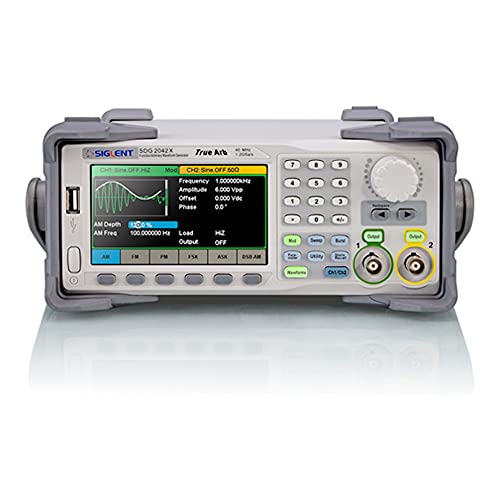
Siglent SDG2042X Waveform Generator
Siglent SDG2042X (40MHz, 2ch, 1.2 GSa/s, 14-bit)
Bandwidth
40 MHz, 2 channels
Sample rate
1.2 GSa/s
Resolution
14-bit
Waveforms
Sine, square, ramp, pulse, arbitrary
Modulation
AM, FM, PM, FSK, PWM, sweep, burst
Interface
USB, LAN
Memory
16 Mpts arbitrary
Price
Under $600
What Works
Genuine bench-grade signal quality
1.2 GSa/s samples arbitrary waves cleanly
Full modulation suite for radio work
LAN + USB remote control
Solid Siglent software ecosystem
The Catch
Premium price for hobby budgets
Heavier than compact DDS units
40MHz ceiling for high-speed work
The Bottom Line: The Siglent SDG2042X is the generator you buy when measurements start to matter. 1.2 GSa/s sampling, a 14-bit DAC, and a full modulation suite put it in a different class from hobby DDS boxes. The price stings, and 40MHz is not RF territory. For audio, control, and MCU work it is the last generator most benches need. A lab engineer: "I stopped checking generator specs after this one. It is simply correct."
The Bottom Line: The Rigol DG1022Z is the standard university-lab generator: two 25MHz channels, a 14-bit DAC, and modulation coverage that handles most coursework and hobby projects. It is a touch short on sample rate for fancy arbitrary waves, and the menus are classic Rigol. For a serious bench on a budget, it is the right default. A student: "I used these for four years in the lab, then bought one the week I graduated."
FeelTech FY6900 (20MHz, 2ch, DDS, frequency counter)
Bandwidth
20 MHz, 2 channels
Sample rate
250 MSa/s
Waveforms
Sine, square, triangle, sawtooth, pulse
Arbitrary
User-defined waveforms
Modulation
AM, FM, PM, FSK, sweep, burst
Display
TFT LCD + frequency counter
Interface
USB
Price
Under $190
What Works
Two channels at a hobby price
Full modulation set for radio experiments
Built-in frequency counter
Small footprint for tight benches
The Catch
Signal fidelity lags Rigol and Siglent
Software is clunkier than the big brands
20MHz ceiling for fast signals
The Bottom Line: The FeelTech FY6900 is the value pick that made DDS dual-channel generators affordable. Two channels, a frequency counter, and a modulation set for under $190 is hard to argue with. The signal is not as clean as the Rigol DG1022Z or Siglent SDG2042X, and the software shows its roots. For hobby labs and radio experiments, it is the smart first generator. A ham: "It is not a lab-grade source. It is the generator that gets you into the hobby, and that is exactly what it should be."
Function generator vs oscilloscope: do I need both?
They do opposite jobs. The generator creates test signals. The oscilloscope measures what the circuit does with them. Most electronics work eventually needs both. Start with a scope, add a generator when you need controlled inputs.
What bandwidth waveform generator do I need?
Match it to your fastest signal. Audio and MCU work: 10-25MHz is plenty. Radio experiments: 40MHz+. High-speed digital: 100MHz+. Buy the bandwidth you will actually use, not the number that looks impressive.
What is the difference between DDS and arbitrary waveform generators?
DDS (direct digital synthesis) generates standard waveforms with precise frequency. Arbitrary waveform adds user-defined shapes loaded from memory. Most modern units do both. The specs to check are sample rate and memory depth.