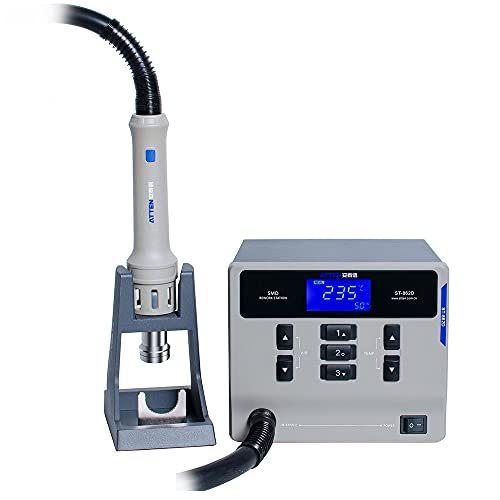
A soldering hot air rework station is a temperature-controlled heat gun with interchangeable nozzles, built for SMD desoldering and PCB repair. What you are buying is tip temperature stability under airflow. Heater power. Airflow range. Nozzle selection. PID temperature control. Here is what separates the stations that lift chips cleanly from the ones that scorch boards. As one repair technician put it: "A hot air station is not a heat gun with a smaller tip. It is a surgeon's tool with a thermostat on the handle."
As an Amazon Associate, I earn from qualifying purchases. SpecRiot is reader-supported. No paid placements. No press samples. No manufacturer relationships.Full disclosure.
What Actually Matters When You Compare Hot Air Guns
Heater power and airflow:1000W heaters (Quick 861DW, ATTEN ST-862D) recover temperature fast under heavy airflow. Weak 300-500W units sag the moment you hit a ground plane and the chip never comes loose. Power is speed. Airflow is control.
Temperature stability: Look for closed-loop PID control with a display that shows the real setpoint. Cheap units drift 30-50°C under load. Quick 861DW holds its setpoint within a few degrees, which is the difference between reflow and regret.
Nozzle selection: A station is only as useful as its nozzles. Quick 861DW ships with 3; the WEP 8858-V includes 3 plus tweezers. A bare-bones kit with one nozzle limits you to one kind of repair.
Blower type:Brushless blowers (Quick 861DW, ATTEN ST-862D) run quieter and last longer than brushed fans. Budget piston pumps surge airflow and wear out. The blower is the engine. Buy a good one.
The Bottom Line: The Quick 861DW is the hot air station the repair community recommends when budget stops being the question. The brushless blower and closed-loop PID deliver stable, quiet airflow that makes BGA and QFP work feel surgical. It costs more than a hobby kit, and it outlasts two of them. As one repair shop owner put it: "The 861DW is the station you buy once and never think about again. Everything cheaper is a rental."
The Bottom Line: The ATTEN ST-862D is the workhorse pick: real 1000W brushless performance at roughly half the price of the Quick 861DW. It does not have the polish or the nozzle kit of the Quick, and the single included nozzle means you will buy a set. For a bench that runs hot air daily without a fortune on the line, this is the sensible middle. A technician: "The ST-862D does 90% of what the expensive stations do. You will never miss the last 10% until you are doing 10 boards a day."
The Bottom Line: The WEP 8858-V is the budget entry that actually works: PID control, three nozzles, tweezers, all under $50. It lacks the power and stability of the Quick 861DW and ATTEN ST-862D, so large boards will test its patience. For hobby SMD work, heat-shrink, and the occasional IC swap, it is honestly impressive value. A hobbyist: "It got me through two years of keyboard builds and drone repairs. I upgraded because I wanted to, not because it died."
Hot air vs soldering iron: when do I need a hot air station?
Hot air is for SMD work: removing ICs, reflowing joints, fixing bridges, and heat-shrink. A soldering iron handles through-hole and point-to-point joints. If you repair phones, boards, or SMD kits, you need both. If you only build through-hole kits, skip the station.
What temperature should I use for desoldering?
Start around 350°C for lead-free boards and 320°C for leaded solder, with moderate airflow. Too much air blows neighboring parts off the board. Start low, add heat, not airflow.
Do I need lead-free capable hot air?
Modern electronics use lead-free solder that melts around 217°C. Any station reaching 400°C+ handles it. The bigger factor is airflow control for BGA work. Temperature range matters less than stability.